
“Nothing is more responsible for the good old days than a bad memory.” -Franklin Pierce Adams
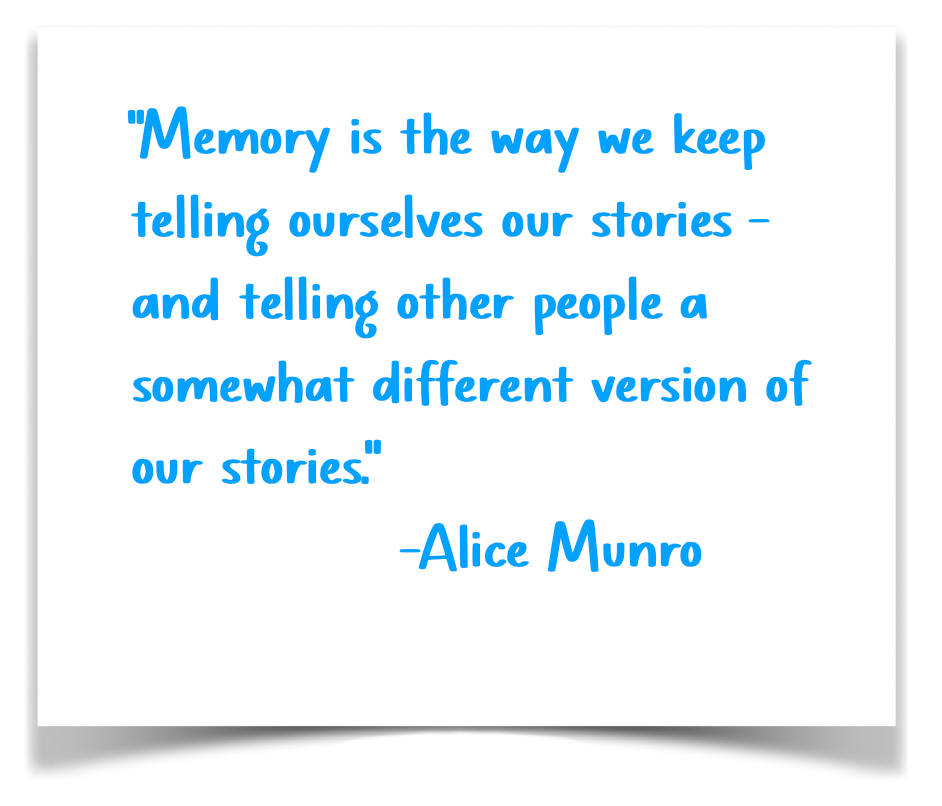
Over time our memories tend to morph and become something very different than they started out. If I talk to my siblings about a family vacation, a holiday celebration, or even everyday life growing up, we have very different memories of the events. Sometimes one of us remembers something very big and important happening that the other two will say never occurred. We aren’t unusual.
As we all experience life’s ups and downs, we see through the lens of our own past, of what we were experiencing that day, and many other factors that can make two, five, or ten people standing together see the same event very differently. One might remember someone hurling an insult that devasted them. Another might have heard it as a joke and yet another might never have heard it at all. We start out with different perceptions so it is certainly no wonder that we remember things differently.
Sometimes our memories soften and mellow because the people involved have passed from our lives over time due to moving, changing jobs, outgrowing an interest, or even due to death. We often remember those folks from our past as if observed through a soft-focus lens. Memories distort, diminish, and disappear over time. And I don’t mean because dementia sets in!

Memories
Like the corners of my mind
Misty watercolor memories
Of the way we were
Scattered pictures
Of the smiles we left behind
Smiles we gave to one another
For the way we were
Can it be that it was all so simple then?
Or has time rewritten every line?
If we had the chance to do it all again
Tell me, would we, would we,
Could we, could we?
Memories
May be beautiful and yet
What’s too painful to remember
We simply choose to forget
Can it be that it was all so simple then?
Or has time rewritten every line?
If we had the chance to do it all again
Tell me, would we, would we,
Could we, could we?
Memories
May be beautiful and yet
What’s too painful to remember
We simply choose to forget
So it’s the laughter
We will remember
Whenever we remember
The way we were
The way we were
The way our memories change things alters not the only the past but also influences how we see the world today. We want things to be the way they always were. The battle cry for this is “we never did it that way before.” Humans are often very opposed to change. They have probably been that way since the dawn of time. Thomas Jefferson acknowledged this in the Declaration of Independence when he said, “mankind are more disposed to suffer, while evils are sufferable, than to right themselves” and change the things “to which they are accustomed.”
As we go along in our lives, we view what is happening today through the lens of our memories. And we don’t have to be old to have it happen. I remember sending high school juniors over to our middle school to work with an eighth grade class. They came back and were shocked by how much make-up those children had on, what their parents allowed them to wear, and the attitudes they had. “We weren’t like that!” they claimed. Ah, but they were.
If you listen to adults have a conversation or look on social media about the way things are today, it is very easy to see that our whole world is going to hell in a handbasket. According to what I hear (from people who last spent a day in a school just before they wore a cap and gown), schools aren’t teaching cursive writing, good books, history, geography, reading, math, and a number of other things that we all learned in school. We hear about how much better people dressed, how much better manners were, and all sorts of other things that are leading to this decay and world destruction.
And to most of it I call BS.
We are afraid of change. We think things should be the way there were as we remember them. I see posts on social media from students I taught in the first decade of the 2000s saying things about students today – and what they are saying is the same as the folks who graduated in the 1980s were saying about them. And don’t get me started with what people my age have to say on everything about the way life is lived today.
I’m an older woman (ahem, I won’t admit to being elderly). I saw a lovely post the other day that showed young women in school back in the sixties. They had on skirts and sweaters, nice shoes, and were sitting very demurely. The caption said something about when we had self-respect or knew what was proper or something else critical of the way things are now. Well, I was in school back then. We wore that because we were not allowed to wear something comfortable. We spent most of the day tugging at our skirts, worrying about whether people could see up our skirts when we sat down, and being embarrassed because we got a run in our stockings. It’s hard to learn when that is what you are focused on. But they looked so much nicer than “these kids today” with their ripped up jeans or the pants worn with the crotch at the knee. They knew to take their hats off indoors. Our parents bemoaned our mini-skirts, boys with long hair and tight pants, and…well, you get the idea.
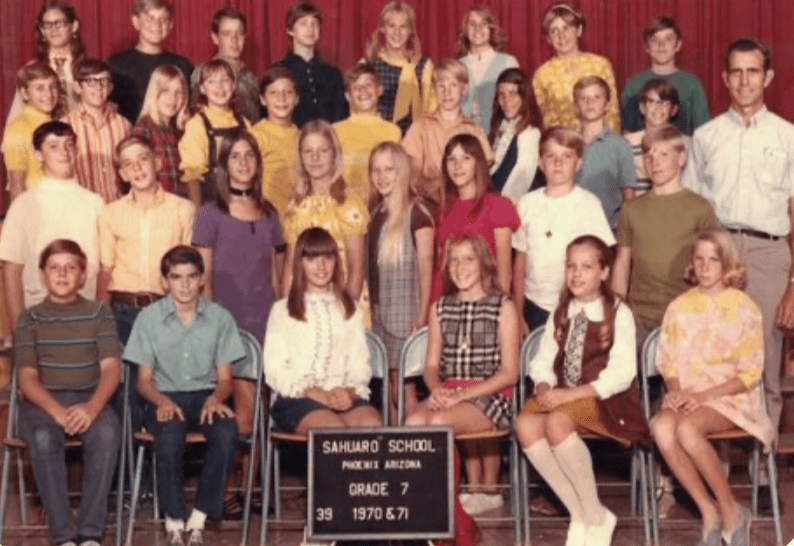
To show how bad some people’s memories become as they years progress, we merely need to look at some of the things people rattle off so often that they’ve become trite. We tell school children that “these are the best years of your life” or “someday you’ll wish you were back here.” Wrong. Be honest. Think back to your school years and take off the blinders. Tests you weren’t prepared for, pop quizes, and homework made your life miserable. Boring teachers droning on made at least one class period a day unbearable. Bullies were always there. Some children were always chosen last for something. Kids were embarrassed by saying the wrong thing, wearing the wrong thing, or any of a thousand other things. Other children made fun of kids for being too fat, too skinny, too tall, too short, too stupid, too smart, too poor, too… And the list goes on. We just like to remember them through rose-colored glasses. There isn’t enough money in the world to make me want to relive those days.
We criticize the current generation for having things we never did. We did fine without cell phones and computers. We learned math without calculators and looked up words in a dictionary. We didn’t choose what gym class we got to take. We didn’t sit inside playing video games. Our parents didn’t drive us everywhere. We walked. Five miles…in the snow…uphill both ways…. We did without some of those things and used others because we didn’t have the technology and inventions that enabled us to learn much more with these tools. We didn’t forgo them.
I remember expressing sympathy for kids taking final exams in a school with no air conditioning, tiny windows, and too many sweaty bodies heating up a room. Another teacher told me, “We did it and survived. They can too.” My response was that when we were children air conditioning was rare. We weren’t accustomed to it and were able to adjust better to heat. Hell, my grandparents raised five children in a two bedroom house with no indoor plumbing. They used an outhouse. They survived it, but that didn’t mean I wasn’t putting a toilet, a tub, an electric washer, and a dishwasher in my house!
Before you wax nostalgic about those halcyon days of our past, stop and think about what was really going on and what it was like. Remember how much work it was to just do household chores before our work-saving inventions came along. We all use them even though our ancestors used a washboard in a tub, boiled water to fill a tub with wather that everyone shared, and took rugs outside to beat them clean.
Before you wish to send us back to the “good old days,” take the time to remember that maybe they weren’t so good for the Jewish neighbor that wasn’t allowed to join your country club; the Black, Hispanic, or Asian family that couldn’t swim in the neighborhood pool; the widowed woman with three kids who couldn’t get a job making a decent wage or buy a house or open a credit card account; or the people who were “different” from all of us who would be prevented from buying a home in certain neighborhoods.
I hear constantly that kids have changed. No they have not. Children come into this world the same way they have since humans appeared on the earth. You know what changed? Adults.
Sure, there were things that were better when I was a kid. But it isn’t because of the technology or that children are different. What we are lacking today is the example of civility and kindness that the children can follow. We lack adult leaders who can carry on civil discourse without name calling and profanity. We lack adults in leadership positions in government and business, media, and others walks of life who will stand up and say that something is wrong, that someone is lying, or that the emperor has no clothes.
We have adults who don’t teach those children manners. Who don’t teach their children to respect their teachers, their community, their elderly relatives. Who will not believe that their child did something wrong. Who want to blame the teacher, the neighbor, or the friends for their children’s behavior. Who allow their children to become addicted to devices. Adults who make it unsafe for the kids to be outside playing and the ones who call the police when they see unsupervised children.
This week at a fun, school event locally a member of the school board and her husband approached a group promoting reading and civic involvement where there were both adults and children. The husband verbally assaulted one of the children before hurling insults and profanities at the adults, trying to start a fight, and becoming quite a show. This is what passes as leadership and adult behavior?
As you look at our society and especially our youth, think carefully. Are you really just uncomfortable with change? Was it really any better when we were young or was it just different? An observer of society once said, “The children now love luxury; they have bad manners, contempt for authority; they show disrespect for elders and love chatter in place of exercise. Children are now tyrants, not the servants of their households. They no longer rise when elders enter the room. They contradict their parents, chatter before company, gobble up dainties at the table, cross their legs, and tyrannize their teachers.” But before you get all charged up agreeing you should know that, according to Plato, Socrates said this, and he lived between 469–399 B.C.


 A Word Aptly Spoken
Leave a Reply